
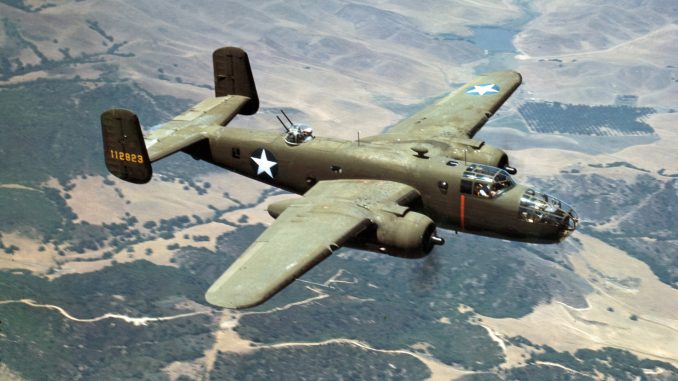
In 1937, the US Army Air Corps began to look for a new twin-engine attack bomber to replace the single-engine types it had on hand. The USAAC solicited for several designs, three of which ended up seeing war service: the Martin XA-22 Maryland, the Douglas A-20 Havoc, and the North American NA-40. North American’s design was initially rejected, but it was re-worked for the Army’s new medium bomber requirement in 1939 and the North American B-25 Mitchell was selected as the winner.
The B-25, named for aviation pioneer BGen William “Billy” Mitchell, initially had a crew of five: pilot, co-pilot, navigator, bombardier, and gunner. It had tricycle landing gear, something of a novelty for the time, and distinctive twin tails. It was powered by two of the dependable Wright R-2600 engines. It could carry a maximum bomb load of 3,000lb over 2,000 miles. The B-25 began to enter service in 1941, and the first groups equipped with the Mitchell began to ship out for the Pacific in early 1942.
The B-25 made its combat debut during the “Royce Mission”, when a detachment of 10 Mitchells purloined from a consignment destined for Dutch service flew to the Philippines in April 1942 and carried out a series of clandestine bombing missions, before evacuating dozens of men. A few days later 16 B-25s flew one of the most famous missions of World War II, the Doolittle Raid, when they took off from the carrier Hornet to bomb Tokyo.
B-25s soon became one of the most important aircraft in the Pacific, serving a variety of roles. When medium altitude bombing results proved poor, the 5th Air Force pioneered low level “skip-bombing” attacks which proved very successful at sinking Japanese shipping. Specialist variants of the B-25 were equipped with extra machine guns and even 75mm guns to make them even more deadly during low altitude attacks. Mitchells were a core component of the 5th, sweeping across New Guinea and into the Philippines as part of MacArthur’s famous return.
Several countries were provided with Mitchells via lend-lease, including Britain, China and the Soviet Union. British B-25s were used in Burma alongside their American counterparts, often being used as transports – Orde Wingate, leader of the famous ‘Chindits’ died when the Mitchell he was travelling in crashed. B-25s were also allocated to the US Marine Corps, which designated them as PBJ Mitchells under the Navy designation system.
B-25s continued in service long after the war ended, with the air forces of several countries continuing to fly them into the 1970s.
Specifications
The South Pacific Air Ferry Route
Mitsubishi Ki-1 Type 93
Leave a Reply